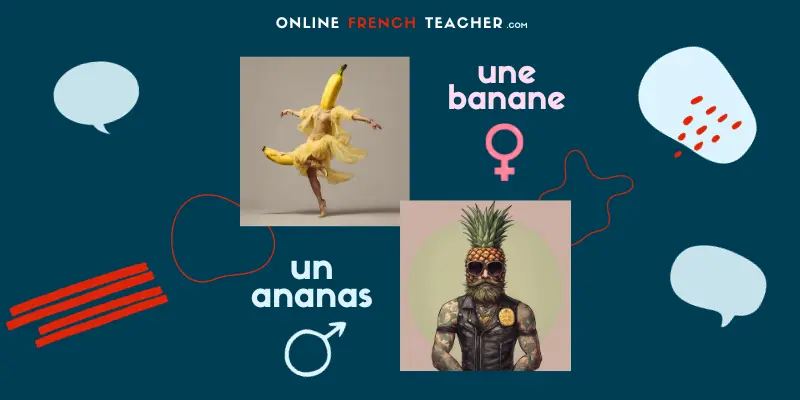
While in English, a word is not identified as feminine or masculine, in French every noun has a gender. In order to speak French correctly, you will have to learn the gender of every noun. But take it easy 🙂 If you are wrong, most of the time French people will still understand what you mean if you pronounce the noun correctly and with the help of the context.
One important thing to understand when learning French is the notion of masculine and feminine. In the French language, every thing is either masculine or feminine. I mean, every item has a gender. In English, you talk about the word table. A table is not female nor male. Well, in English perhaps, but in French a table is a female, or I’d rather say a feminine word.
Explications grammaticales de base pour connaitre le genre des noms – Basic grammatical explanations to know the gender of French nouns
L’importance d’apprendre l’article avec le nom – The importance of learning the article with the noun
Most of the time, when a noun is pronounced, it will come with an article like le or la. for instance. In the case of the word table, you can guess that it is feminine with the article une or la coming before the word table. If a noun is masculine, we use the article un, or any other article in the masculine version, in front of the noun. We say for example un téléphone (a phone). It is quite important to know the gender of French nouns because all the words associated with the nouns will adapt to the gender. The article will be feminine or masculine according to the gender of the noun.
Les adjectifs aussi ont une version masculine et féminine – Adjectives also have masculine and feminine versions
The adjectives related to the nouns also change accordingly to the gender of the French nouns.
🎧
🇫🇷 French
🇬🇧 English
une petite table
a small table
un petit téléphone
a small phone
As you can see, the adjective small has a masculine and a feminine versions (petit and petite). The pronunciation of the adjective in that case, and quite often, is different. If you want to speak correct French, then you have to know if a noun is masculine or feminine.
Ce que nous avons appris jusqu’à présent – What we have learnt so far
a French noun is either masculine or feminine
you can figure out the gender of French nouns by looking at the article before the noun (most of the time)
the words related to the nouns become feminine or masculine, according to the gender of the nouns
not only the spelling of some words can change depending if they are masculine or feminine but the pronunciation can be different as well (petit ≠ petite , un ≠ une)
Existe-t-il un moyen de connaître le genre des noms français ? – Is there a way to know the gender of French nouns?
Apprend l’article avec le nom – Learn the article with the noun
Sorry, there is no magic trick to know the gender of French nouns. 😔 My best advice is to learn every new noun with the article coming before the noun. So, if you learn the word ordinateur in French, which means computer, it is important to learn how to say in French a computer. a computer is a male in French 😛, we say un ordinateur.
Masculine articles are un (a) or le (the). Feminine articles are une (a) or la (the).
Des catégories de noms selon les lettres finales – Noun categories based on the final letters
However, there is a list of rules, categorising nouns depending on the ending of the words. It can help to know these categories even though this is not an exact science, meaning it can help you to guess but for almost every category, there are exceptions. At least if you have no clue about the gender of French nouns, it will give you a lead 😉.
⚠️ If a noun ends with the letter “e“, it doesn’t mean it is feminine. ⚠️
Terminaisons qui aident à deviner que le genre est masculin – Endings that help you guess that the gender of French nouns is masculine
These noun endings should help you guess the gender of French nouns when they are masculine.
Les noms qui terminent en -age – Nouns ending in -age
🎧
🇫🇷 French
🇬🇧 English
le courage
the courage
le partage
the sharing
Les noms qui terminent en -isme – Nouns ending in -isme
🎧
🇫🇷 French
🇬🇧 English
le capitalisme
the capitalism
le socialisme
the socialism
Les noms qui terminent en -ment – Nouns ending is -ment
🎧
🇫🇷 French
🇬🇧 English
le développement
the development
un moment
a moment
Les noms qui terminent en -eau – Nouns ending in -eau
🎧
🇫🇷 French
🇬🇧 English
un bateau ⛵️
a boat
un chapeau 🎩
a hat
Les noms qui terminent en -phone – Nouns ending in -phone
🎧
🇫🇷 French
🇬🇧 English
un téléphone ☎️
a phone
un saxophone 🎷
a saxophone
Les noms qui terminent en -scope – Nouns ending in -scope
🎧
🇫🇷 French
🇬🇧 English
le télescope 🔭
the telescope
le microscope 🔬
the microscope
Terminaisons qui aident à deviner que le genre est féminin – Endings that help you guess that the gender of French nouns is feminine
After watching this video, thanks to Paul Taylor, you should remember that the word “eau” (water) in French is feminine 😂
These noun endings should help you guess the gender of French nouns when they are feminine.
Les noms qui terminent en -té – Nouns ending in -té
🎧
🇫🇷 French
🇬🇧 English
la beauté 💄
the beauty
la santé 🩺
the health
Les noms qui terminent en -tion – Nouns ending in -tion
🎧
🇫🇷 French
🇬🇧 English
la communication 📡
the communication
l’information
the information
Les noms qui terminent en -ade – Nouns ending in -ade
🎧
🇫🇷 French
🇬🇧 English
une promenade
a walk
une salade 🥗
a salad
Les noms qui terminent en -ie – Nouns ending in -ie
🎧
🇫🇷 French
🇬🇧 English
la philosophie
philosophy
la vie
life
Les noms qui terminent en -ure – Nouns ending in -ure
🎧
🇫🇷 French
🇬🇧 English
une lecture
a reading
la voiture 🚙
the car
Les noms qui terminent en -ance – Nouns ending in -ance
🎧
🇫🇷 French
🇬🇧 English
l’indépendance
the independence
la chance 🍀
luck
Les noms qui terminent en -ence – Nouns ending in -ence
🎧
🇫🇷 French
🇬🇧 English
une différence
a difference
la démence 🤪
insanity
Les noms qui terminent en -sion – Nouns ending in -sion
🎧
🇫🇷 French
🇬🇧 English
l’expansion
expansion
une illusion
an illusion
Les noms qui terminent en -ette – Nouns ending in -ette
🎧
🇫🇷 French
🇬🇧 English
la sonnette 🛎
the doorbell
une fourchette
a fork
Les noms qui terminent en -ude – Nouns ending in -ude
🎧
🇫🇷 French
🇬🇧 English
la solitude
loneliness
une étude
a study
Les noms qui terminent en -ère / -erre – Nouns ending in –ère / -erre
🎧
🇫🇷 French
🇬🇧 English
la lumière 💡
the light
la terre 🌍
the earth
Les noms qui terminent en -elle – Nouns ending in –elle
🎧
🇫🇷 French
🇬🇧 English
la poubelle 🗑
the bin
une hirondelle
a swallow
Les noms qui terminent en -esse – Nouns ending in –esse
🎧
🇫🇷 French
🇬🇧 English
la paresse
laziness
la tendresse
tenderness
Les noms qui terminent en -oie / -oix – Nouns ending in -oie / -oix
🎧
🇫🇷 French
🇬🇧 English
la voix
the voice
la joie
joy
Les noms qui terminent en -ille – Nouns ending in –ille
🎧
🇫🇷 French
🇬🇧 English
la famille
the family
une grenouille 🐸
a frog
Les noms qui terminent en –ue – Nouns ending in -ue
🎧
🇫🇷 French
🇬🇧 English
la rue
the street
la vue
the view
À RETENIR
WORTH REMEMBERING
Knowing if a noun is masculine or feminine is important in French because all the words around the word will have as well a masculine or feminine version.
But don’t worry 🧘🏾, as a beginner your objective is NOT to speak perfectly. Instead, your objective is to be understood. And the good news is French people will understand you most of the time even if you are wrong about the gender of a noun.
So this lesson gives you hints and could help you with this gender thing 😅
My best advice is: when you learn a new noun, learn it with the article before
➡️ e.g. learn la pomme instead of pomme, so you will remember that une pomme is a (pink?) lady 😁
Scroll down and…
🤩 Rate this lesson 👀 Read other students’ comments ✍🏼 Leave your own comments